
Fernando Mendoza’s Unusual Sideline Routine: How the Raiders’ No. 1 Pick Is Preparing From the Bench
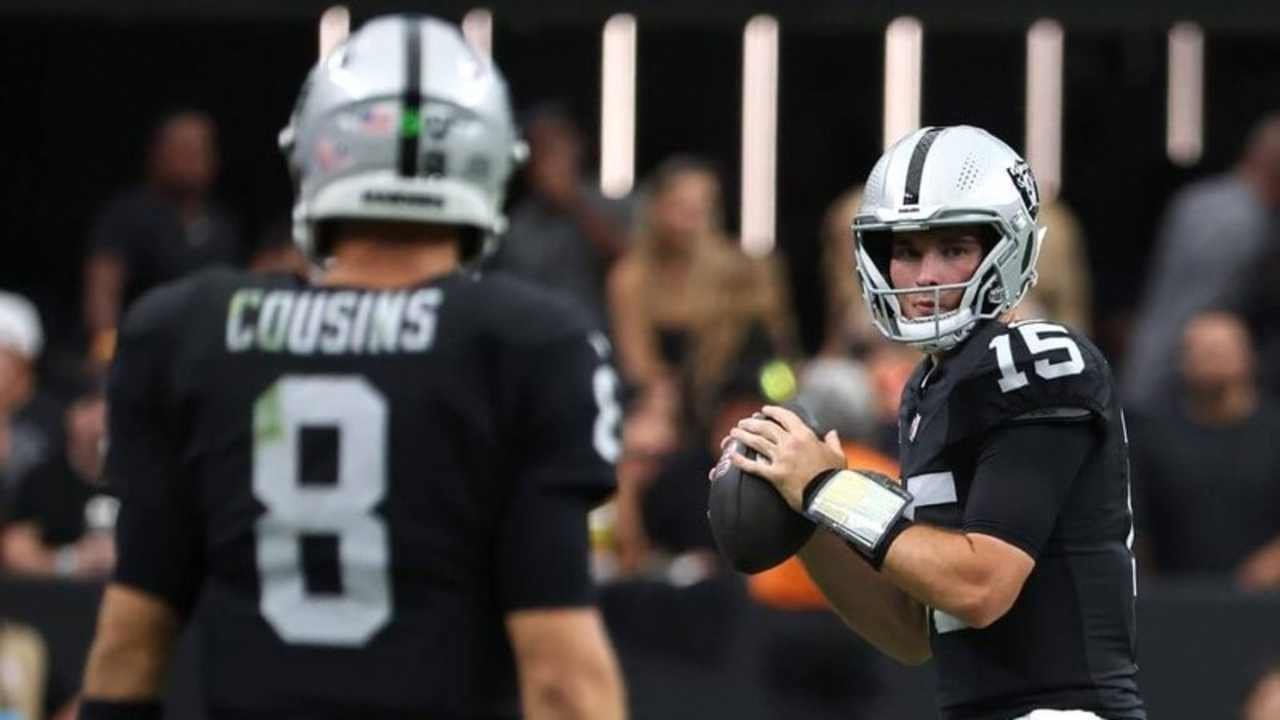
HENDERSON, Nev. — Fernando Mendoza had every reason to feel anxious. As the first overall pick in the NFL Draft, all expectations pointed to him commanding the huddle and taking the field when the Las Vegas Raiders opened their season against the Miami Dolphins. Instead, he sat on the sideline, chin strap fastened and helmet on, listening to a different voice — that of head coach Klint Kubiak — echo through his helmet.
Below his cleats, the turf at Allegiant Stadium was spray-painted white. Thirty yards away, veteran quarterback Kirk Cousins was taking snaps, playing the game Mendoza was preparing for without ever stepping onto the field himself. It was the first time since 2018 that the No. 1 pick in the NFL Draft did not start his team’s season opener.
Yet Mendoza was not idle. Far from it. The rookie was engaged in a preparation routine so immersive that it blurred the line between watching and playing.
The Season Opener Surprise
When Kubiak announced on September 2 that Cousins would start the opener, the decision raised eyebrows across the league. The rookie quarterback — widely expected to begin his career under center — was instead asked to serve as the veteran’s backup. The move was not a reflection of Mendoza’s ability, according to the organization, but a deliberate developmental choice. The Raiders believed that letting the rookie observe from behind Cousins would accelerate his growth in ways that no amount of practice reps could replicate.
For Mendoza, the decision was a challenge to his patience — and an opportunity he chose to embrace fully.
A Sideline Process Like No Other
Mendoza’s preparation on game day goes far beyond passive observation. On every offensive play the Raiders ran during the season opener, the rookie went through his entire process as though he were the one under center. He conducted his footwork, worked through his passing progression, and even broke the huddle — a huddle of one — after relaying Kubiak’s call to imaginary teammates.
“I’m so locked in,” Mendoza admitted, acknowledging that there were moments during the game when his focus was so intense he caught himself almost going through his dropback and throwing motion alongside Cousins.
Unlike most backup quarterbacks, who often rely on a headset or earpiece and wear a baseball cap, Mendoza chose to wear his full helmet throughout the game. When asked why, his answer was straightforward: “I’m not holding this big helmet up (to my ear)” to hear the play call. He was never offered a headset and did not know it was an option. To Mendoza, wearing the helmet added to the realism of what he was doing — experiencing the play calls and the visual environment as closely as possible to what he would face on the field.
“Wearing the helmet is pretty crucial because that’s where the play calls come in through, and that’s the microphone you hear from the speaker,” Mendoza explained. “When I wear the helmet, I can (experience) what I would actually see on the field.”
Working With the Coaching Staff
Mendoza’s sideline routine was shaped by a collaborative effort between himself and the coaching staff. Quarterbacks coach Mike Sullivan has been instrumental in developing the rookie’s game-day process. During practice, Sullivan uses a drill known as “America’s Drill,” in which Mendoza walks through each play, executing his footwork and progression reads before Cousins leads the starters against the scout team.
Offensive coordinator Andrew Janocko and Sullivan originally conceived of the sideline process Mendoza uses on game days. Kubiak described it as part of the team’s broader effort to “find every edge that we can to keep getting him ready to play.”
On game days, Mendoza stays close to Sullivan’s side. After his pretend huddle, he briefs Sullivan on everything the opposing defense could do based on look and personnel, and explains how he would react to each scenario. Sullivan responds with additional scenarios or thoughts, and the two go back and forth before watching the play unfold together. They quickly debrief and move on to the next snap.
Janocko highlighted the dual benefit of the approach: “You’re getting game reps, and that’s twofold. That goes for down the road and prepping to play, but that also puts you in that game. So, when your number is called, whether it be the next snap or a while down the road, you’re establishing yourself for game reps.”
Why Verbalization Matters
At the core of Mendoza’s process is a deep commitment to verbalization. He believes that saying the play call aloud with Sullivan reaffirms the call mentally, reinforces his decision-making process, and builds both muscle memory and mental memory over time. This practice — hearing the call, speaking it, and then visualizing his responses — mirrors what he does during walkthroughs and training sessions.
Mendoza is a firm believer that the repetition of saying and hearing the play call creates a level of preparation that silent observation alone cannot achieve. It is why he chose the helmet over a headset: full immersion in the auditory experience of the game-day environment.
Learning From Cousins Up Close
Much of Mendoza’s growth has come from watching Cousins operate at the game speed he will soon face himself. The rookie says he has already learned plenty from a single game observing the veteran, including the importance of efficiency and the razor-thin margin for error at the professional level.
“How efficient you need to be to win,” Mendoza said of his takeaways. “The margin for error is smaller. It gets smaller from practice to the preseason to then the actual games. Windows are tighter. Everything is harder.”
Mendoza says his process for watching Cousins on game days mirrors what he does during walkthroughs: he mimics Cousins’ every action, hearing and saying the play call, then making mock decisions about his throwing progression on passing plays. He also watches Cousins, Janocko, and Sullivan meet on the sideline during offensive series, studying how they consult on the iPad, review plays, and make corrections.
“I watch them get on the iPad, go through plays, watch them make sure we’re making all the corrections,” Mendoza said. “I want to be there and engage with that. Then I can ask any additional questions to coach Sullivan or coach Janocko if needed.”
His interactions with Cousins themselves were kept to a minimum during the game. Mendoza offered to serve as a “second set of eyes” on anything the veteran was unsure of and discussed a few coverages, but he was careful not to distract from Cousins’ focus. Between plays, Mendoza was spotted helping teammates — including fixing star center Tyler Linderbaum’s shoulder pads on one occasion — and congratulating Cousins after each of his three touchdowns.
A Tradition Among Backup Quarterbacks
Mendoza’s approach is far from unique in the NFL. Cousins himself served as a backup during the 2012 season in Washington behind rookie Robert Griffin III, and he followed a similar protocol of staying engaged and ready at all times.
“Just kind of staying in it at all times and being ready at any moment,” Cousins said of his mindset as a backup. “That’s kind of always the journey when you’re one player away.”
Aidan O’Connell, who served as third-stringer behind then-Raider starter Jimmy Garoppolo as a rookie before starting the final nine games of the 2023 season, told Mendoza he has used the same approach in each of his seasons with Las Vegas. Kubiak echoed the sentiment: “Any No. 2 quarterback, they’re listening to the call. They’re saying it in their head what they’d be going through progression-wise, check-wise, putting themselves in the game on every snap.”
The difference, in Mendoza’s case, is the level of visible immersion — helmet on, calling plays aloud, and working through every detail with his coaches in real time.
Patience and the Bigger Picture
Mendoza desperately wants to play. But for now, he is embracing the Raiders’ plan, trusting that the sideline experience will prepare him for the moment his number is called. He sees value in studying the battle rhythm — how plays are installed during the week, how they are practiced, and how they materialize on game day under Kubiak’s direction.
“I think it’s going to help me going forward to see the battle rhythm,” Mendoza said. “Really see the battle through the week of how we install plays, how we practice plays and how they show up on game day with coach Kubiak doing it. Obviously, he was very successful last week, so I’m excited to keep on staying engaged and keep on learning and developing.”
The Raiders’ strategy reflects a long-term investment in their franchise quarterback. Rather than rushing Mendoza into action, the organization is giving him every tool to succeed when the time comes — including a front-row seat to professional quarterback play, a coaching staff committed to his development, and a process that demands the same intensity on the sideline as on the field.
When Mendoza eventually takes the field as the Raiders’ QB1, he will carry with him not just theoretical knowledge but lived, simulated experience from every game he has watched from behind. In a league where preparation can separate good quarterbacks from great ones, the rookie is already proving he is willing to do whatever it takes.
This article originally appeared in The Athletic.
Sports, News, Entertainment, People, NFL, Football, Las Vegas Raiders, NFL Draft, Quarterback, Allegiant Stadium, Football Training, Football Strategy, Mike Sullivan, Klint Kubiak, Kirk Cousins, The Athletic, Player Development

