
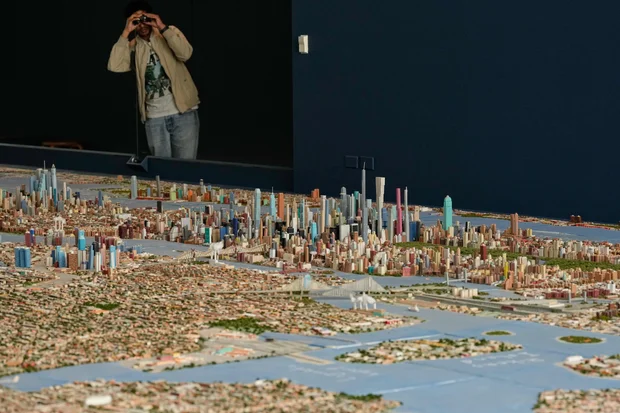
“He Built This City”: Truck Driver’s 20-Year NYC Scale Model Finds a Home at the Museum of the City of New York
For more than two decades, truck driver Joe Macken dedicated his spare time to a singular passion: constructing a massive, street-level scale model of his native New York City — entirely by hand, out of balsa wood and foam board. When his daughter convinced him to share the sprawling basement creation on TikTok, the videos went viral almost instantly, eventually drawing the attention of the Museum of the City of New York. The result is “He Built This City,” a major exhibition that opened in February along Manhattan’s museum row near Central Park and runs through October 12.
What began as a private obsession in a Queens basement has become one of the most talked-about cultural attractions in New York City this year — a testament to the power of devotion, craftsmanship, and a deeply personal love for a city that never stops changing.
A Lifelong Obsession: How Joe Macken Built a Miniature New York
Macken’s inspiration traces back to an elementary school trip to the Queens Museum, where he encountered the Panorama of the City of New York — the famed scale model originally built for the 1964–1965 World’s Fair, which featured an overhead helicopter-style gondola ride. But it wasn’t until his 40s that the Queens native actually set out to recreate the city himself. At the time, Macken and his young family had relocated north from Long Island to the Albany area in upstate New York.
“I think, subconsciously, I might have missed New York,” he said.
Using basic materials from hobby shops, Macken began with Rockefeller Center and its iconic main tower, “30 Rock.” From there, he expanded into Midtown Manhattan — a process that alone took roughly a decade. The Empire State Building and its ornate Art Deco spire proved especially challenging. “I wanted to make it perfect,” Macken said. “People are gonna be looking at it.”
Macken has no formal background in model building, architecture, or design. He jokes that his closest prior experience was assembling Legos and Lincoln Logs as a child. But through repetition and dedication, he became remarkably proficient. “I wish I would have done it 20 years earlier, knowing that I would have enjoyed it so much,” he said. “I can build one of the buildings in my sleep right now where it took me hours when I first started.”
Nearly all of his free time was consumed by the project. He packed his building materials on family trips to the New Jersey shore and worked during lulls while driving a bus on weekends. “It was just something that I couldn’t stop doing.”
Inside “He Built This City” at the Museum of the City of New York
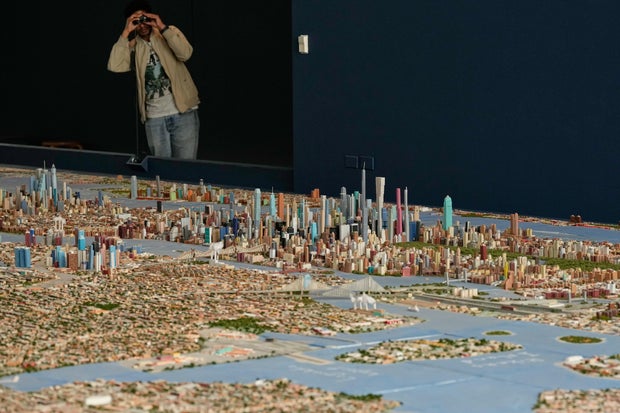
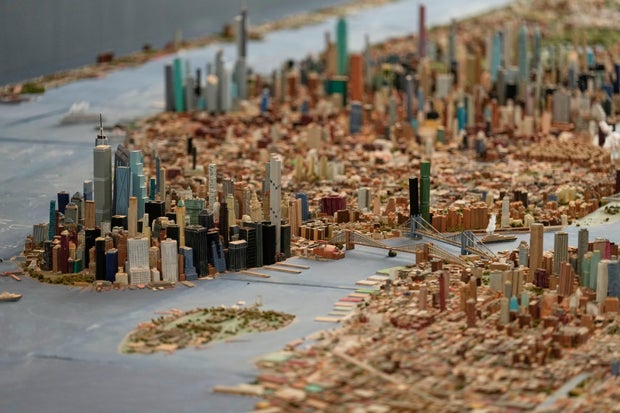
The finished model spans all five boroughs and even reaches into parts of New Jersey and suburban Long Island. Laid out in street-level detail across more than 300 large foam boards interconnected like puzzle pieces, the entire installation stretches 50 feet long (15 meters) and nearly 30 feet wide (9 meters). At a scale where each inch represents about 160 feet, the model contains over 800,000 individual structures — from Manhattan’s towering skyscrapers to humble single-family homes in Queens.
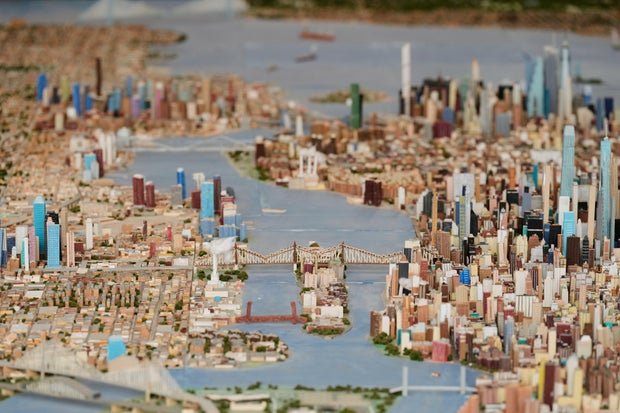
Landmarks like the Statue of Liberty, Yankee Stadium, and the Brooklyn Bridge are all rendered in meticulous detail, crafted primarily from light balsa wood. The museum’s chief curator, Elisabeth Sherman, described the model as a rare piece that bridges online audiences and traditional museum visitors.
“I think people always want to get their arms around this whole city, this city that is impossible to know, impossible to grasp, and this is a way to see it from a bird’s-eye view,” she said. “We rarely have anything these days that reaches everyone in that way. We love that kind of energy it brings.”
What Makes the Model Uniquely Personal
The model is not an exact snapshot of today’s metropolis. Macken wove deeply personal touches throughout the miniature landscape. In Queens, he recreated his favorite childhood diner rather than the modern high-rise that now occupies the site. He preserved the old Kosciuszko Bridge connecting Brooklyn and Queens — demolished in 2017 and replaced by a new span — because it held meaning for him.
And in lower Manhattan, the old Twin Towers of the World Trade Center still stand alongside One World Trade Center and the gleaming skyscrapers built after the September 11, 2001 terror attacks.
“I kept a lot of my own parts of the city,” Macken said. “Just for me.”
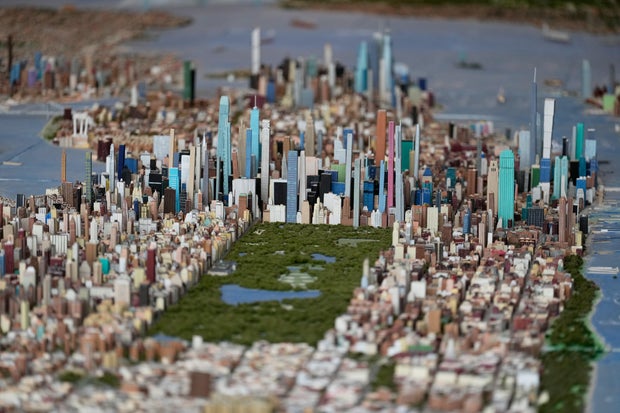
These personal choices transform the model from a mere technical achievement into something closer to a memory map — a reflection of how one New Yorker has experienced and remembered his city across decades of change.
From TikTok Viral Fame to Museum Showcase
Macken never seriously considered finishing the model, he admitted — he simply enjoyed building it. That changed when his daughter persuaded him to post clips on TikTok. The videos quickly accumulated more than 10 million views in a single week, catching the eye of the Museum of the City of New York, which reached out to Macken about a formal exhibition.
The exhibit’s viral-to-institution pipeline highlights a broader trend in which social media platforms have become genuine discovery channels for museums and cultural institutions. Sherman noted that the model appeals to both younger audiences who first encountered it online and traditional museum-goers, offering what she called a rare kind of shared energy.
Visitors Finding Personal Connections
On a recent weekday morning, a steady stream of visitors filed into the first-floor gallery. Many approached the raised platform instinctively, scanning for familiar landmarks or old neighborhoods. Some used the binoculars provided for closer inspection; most simply squinted and pointed into the distance.
One visitor, Jonathan Skolnik, positioned himself at the corner nearest lower Manhattan and traced his family’s history across the five boroughs as his son, Tosha, listened. He pointed out his father’s first address in America on Manhattan’s Lower East Side, near the foot of the Williamsburg Bridge, the Queens neighborhood where he was born, and the cemetery where family members were buried.
“I’m trying to do it all from memory,” the Washington, D.C. area resident said. “I don’t have it all exact.”
Moments like these underscore what the museum hoped the exhibit would achieve: not just a display of craftsmanship, but a portal through which diverse visitors can connect with their own relationship to New York City.
What’s Next After the Museum Exhibit
After a lifetime toiling in anonymity as a truck driver, Macken hopes to display the model at other venues once the museum exhibition concludes on Columbus Day. He also intends to continue expanding it, adding more than 50 new buildings and extending the layout further into New Jersey and Long Island.
“He Built This City” is currently on view at the Museum of the City of New York, located along Fifth Avenue near Central Park. It represents a remarkable intersection of folk art, personal storytelling, and civic pride — and a reminder that extraordinary things can be built with patience, passion, and a few sheets of balsa wood.
“I never really thought about finishing it because I had so much fun building it.” — Joe Macken
Arts, Entertainment, Hobbies, People, News, Online, Transportation, Communities, New York City, Museums, Queens, Manhattan, Brooklyn, Long Island, New Jersey, World’s Fair, Positive

