
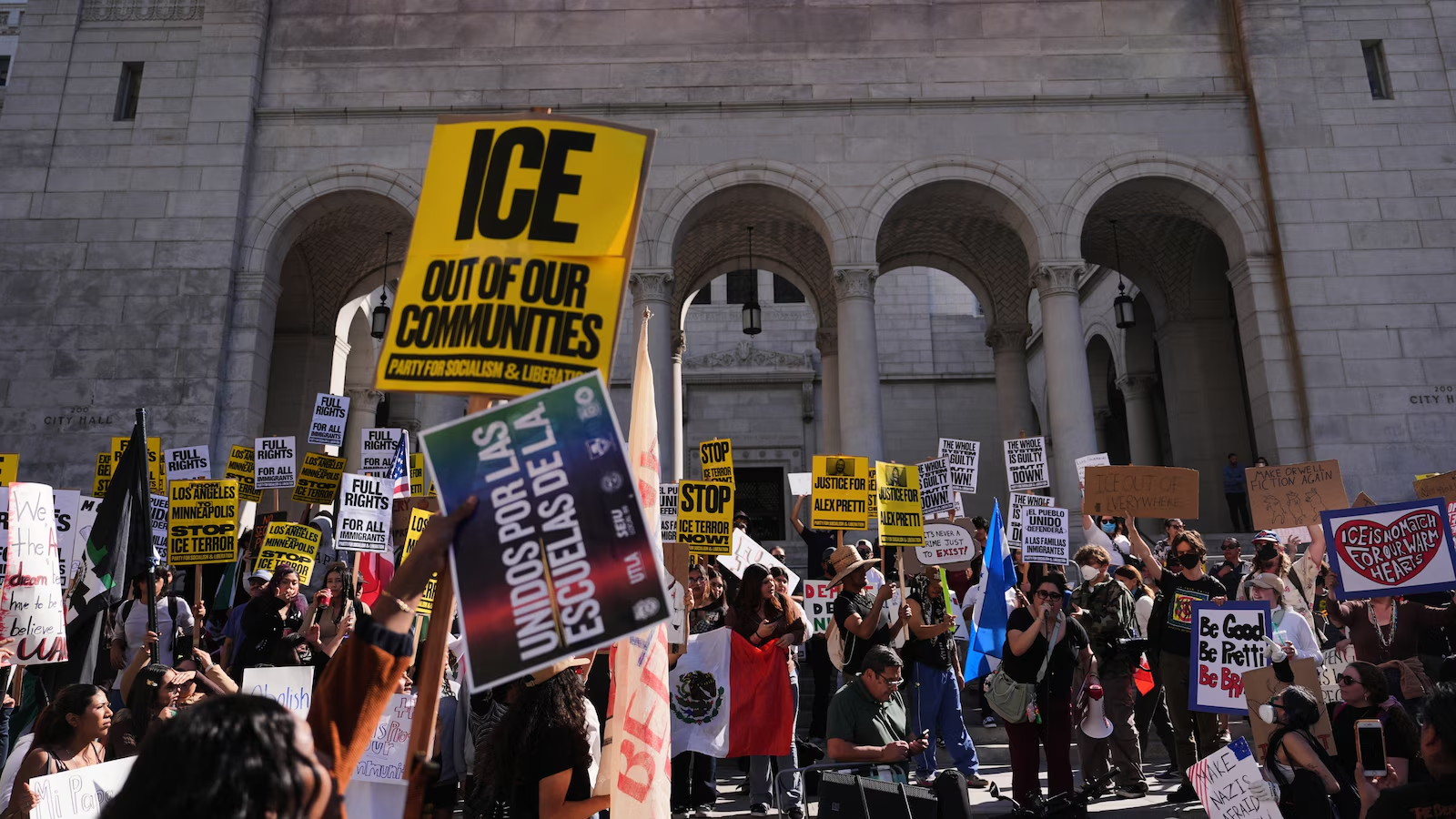
Federal Judge Blocks Warrantless Immigration Arrests Across Southern California
A federal judge has issued a preliminary injunction effectively curtailing warrantless immigration arrests across much of Southern California, requiring immigration officers to establish a demonstrated likelihood that a person would flee before detaining them without a warrant. The ruling, handed down by U.S. District Judge Maame Ewusi-Mensah Frimpong, represents a significant legal setback for federal immigration enforcement efforts in the region and reflects a growing judicial pushback against expansive arrest practices.
Background: A Surge in Enforcement and a Coordinated Legal Challenge
The lawsuit was filed last fall by the American Civil Liberties Union of Southern California, Public Counsel, and local Los Angeles immigrant advocacy groups amid what they described as an unprecedented surge of immigration enforcement activity throughout the region. The legal action targeted sweeping operations conducted by federal immigration agents, including roving patrols that stopped and arrested individuals based largely on characteristics such as race, language, and occupation.
The ruling applies within the Central District of California, a jurisdiction encompassing Los Angeles, Orange, Riverside, San Bernardino, Ventura, Santa Barbara, and San Luis Obispo counties — an area that serves as both a major economic hub and a historic center of immigrant communities.
Frimpong had previously issued a temporary restraining order aimed at restricting those broad enforcement operations, but that order was lifted by the U.S. Supreme Court in September of the previous year. Justice Brett Kavanaugh noted at the time that apparent ethnicity could potentially serve as a relevant factor in evaluating a stop, provided it was combined with additional information.
What the Preliminary Injunction Requires
The unsealed preliminary injunction, issued on September 2 and formally released later that month, imposes several critical requirements on federal immigration authorities:
- Escape risk assessment: Officers must consider the “totality of the circumstances known to the agent or officer” regarding a person’s likelihood of fleeing before making a civil immigration arrest without a warrant. The mere fact that someone is present in the country without authorization is not, by itself, sufficient grounds for a warrantless detention.
- Documented probable cause: The government must thoroughly document the probable cause underlying each arrest before a warrant can be sought. Judge Frimpong emphasized that without such documentation, the government cannot demonstrate that any arrest was legally proper.
- No blanket policies: The court found that the government’s existing approach amounted to conducting escape risk evaluations based solely on unlawful immigration status — or, in many cases, conducting no assessment at all, or relying on what the court characterized as “false assertions.”
Frimpong also denied the government’s request to stay or delay the order while it pursued an appeal, meaning the injunction took effect immediately.
The Evidence Behind the Ruling
Frimpong’s decision was grounded in what she described as a “wealth of record evidence,” including government directives, arrest narratives, agent depositions, and video footage. One case illustrated the problem vividly: the government claimed an individual was “running away” from immigration agents prior to being questioned. However, video evidence showed the man walking at a normal pace and texting on his phone before any agent initiated questioning.
Plaintiffs’ attorneys presented evidence that in numerous tracked arrests across Southern California, no documentation whatsoever was produced to show that officers had evaluated the likelihood of escape. Federal attorney Daniel Mummolo acknowledged that different arresting officers handled the process differently and pointed to a January 2026 memo issued by former acting ICE director Todd Lyons that permitted officers to make “on-the-spot” determinations about flight risk. However, Mummolo conceded he had not presented evidence of officers actually following through on those verbal assessments.
In response, Frimpong pressed him on the lack of documentation: “You have not presented evidence of officers saying, ‘Yeah I didn’t write it down but I did do it,'” the judge remarked.
Plaintiffs’ attorney Laura Perry Stone further argued that the Lyons memo required officers to determine both that a person was likely to leave the immediate location and that they were unlikely to be found at another identifiable location, such as their home or workplace — a standard the court ultimately found was not being met.
A Growing Pattern of Judicial Opposition
Frimpong’s ruling is not an isolated decision. Federal judges in Portland, Colorado, Washington, D.C., and the Eastern District of California have independently issued similar orders blocking warrantless immigration arrest practices within their respective jurisdictions. The consistency of these rulings across geographically dispersed courts signals a broader judicial consensus that the federal government’s approach to warrantless civil immigration arrests has lacked the legal foundation and procedural safeguards required by law.
The ACLU has signaled its intention to actively monitor compliance with the new order. Mayra Joachin, an attorney with the ACLU of Southern California, stated: “This court order should put an end to hundreds – if not more – of unlawful arrests that continue throughout Southern California. We will closely monitor compliance with this court order, and expect the federal government to abide by it.”
What Comes Next for Immigration Enforcement in California
The immediate practical effect of the injunction is that immigration officers operating within the Central District of California will need to adopt more rigorous documentation practices and demonstrate individualized grounds for warrantless arrests. The ruling does not prohibit warrantless arrests outright, but it establishes a meaningful legal threshold that previously was not being applied in practice.
For immigrant communities across Southern California, the order offers a measure of legal protection and a formal judicial acknowledgment that the existing enforcement practices were inadequate. However, the government retains the option to appeal, and the case is likely to continue evolving through the federal appeals process.
Meanwhile, the U.S. Department of Homeland Security did not immediately respond to a request for comment following the issuance of the injunction, leaving open the question of how federal agencies will respond to the court’s directives in the coming weeks and months.
The ruling also leaves unresolved the broader questions surrounding roving patrol operations and access to counsel for detained individuals — issues the original lawsuit sought to address but that were not fully resolved by the preliminary injunction. As immigration enforcement continues to be a flashpoint across the nation, the legal battle over the boundaries of warrantless arrests shows no signs of concluding.
News, Law, Government, Society, Immigration, Civil Liberties, Los Angeles, California, Federal Courts, Constitutional Law, U.S. Immigration and Customs Enforcement

