
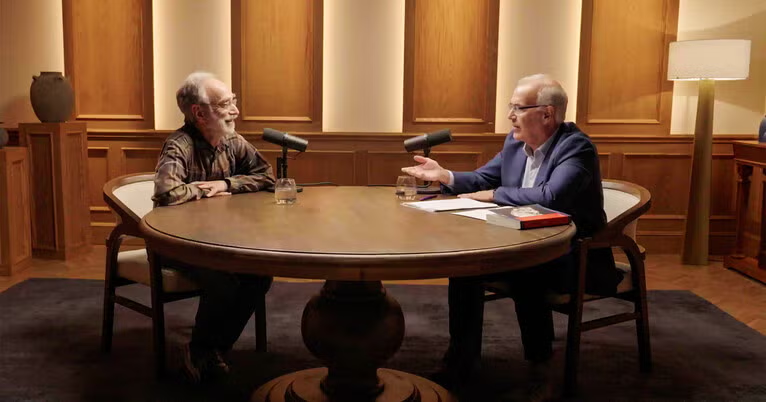
David Brooks Launches ‘The Permanent Questions’ Podcast at Yale
Launch of ‘The Permanent Questions’ Podcast
The Atlantic, in partnership with Yale University, has launched a new weekly video podcast titled “The Permanent Questions,” which debuted today.
Humanist Dialogue in the Age of AI
The podcast features conversations with academics, teachers, and other experts on fundamental questions of the humanist tradition, encouraging deep reflection on the purpose and meaning of life.
What Are the Permanent Questions?
David Brooks: They’re the big ones, like, how do you find a purpose in life? How do you think about your own death? How does that change how you live? These are just basic questions of, where should my priorities be? What do I really desire? Anything that touches the subjective nature of our being. If we want to live full lives, we all have to answer these questions.
Addressing Societal Woes and Moral Order
Brooks: Yes. Historically, major technological advances have triggered humanistic counter‑reactions. In the 19th‑century industrial revolution, figures such as Matthew Arnold, William Wordsworth, Samuel Coleridge, Henry David Thoreau, and Ralph Waldo Emerson argued that society would not become machines and that a humanistic core must be preserved. Today, amid rapid advances in social media and AI, a similar humanistic push‑back is needed to protect the unquantifiable, essential aspects of humanity.
A Platform for Humanist Conversation
Brooks: The podcast is part of a broader meta‑analysis of how public discourse can help us lead better lives. My career has been devoted to exploring these ideas publicly, writing books on emotions, character, suffering, and human connection to become less shallow.
Why College Students Should Engage Now
Brooks: This is the best time for students to contemplate big questions. Their minds are highly malleable and already eager for deep ideas. The current generation faces higher mental‑health challenges, greater pessimism, and declining rates of love, romance, marriage, fertility, patriotism, and religious observance—trends that suggest a need for meaningful dialogue about purpose and values.
Seeking Diverse Perspectives
Brooks: Yes, featuring scholars with differing views makes the conversation richer. For example, with Shelly Kagan, I disagree on the existence of the human soul, which makes the discussion more engaging. I will also speak with philosopher Megan Sullivan (University of Notre Dame) on whether a Great Books education can transform a life, pressing her for concrete answers.
Can a Podcast Change a Life?
Brooks: Words are powerful; a great conversation can spark lasting friendships or even romantic love—my own 12‑hour phone call with my wife began that way. Thoughtful dialogue has the potential to influence lives profoundly.
Future of Yale Talks and Audience Reach
Brooks: The surprising viewership of my recent Yale “Conversations” talks—covering topics such as “How to be Ambitious Without Being a Jerk”—shows strong public interest. I will continue producing these talks, including one on “the war for America’s soul,” and aim to reach younger audiences through a video podcast format, recognizing that younger viewers increasingly consume podcast content.
Yale’s Academic Environment as a Platform
Brooks: Having taught at Yale intermittently since the 1990s, I feel at home there despite criticism of elite admissions and the increasing pre‑professional focus. Yale hosts many outstanding teachers whose classroom impact exceeds that of published research. I want to showcase the diverse activities within an elite university—far richer than its public image—by highlighting these great educators.
The new podcast, alongside Yale’s existing lecture series, aims to broaden public engagement with the liberal arts, offering a platform for deep, human‑focused discussions in an era of rapid technological optimization.
Categories: News, Society, Education, Technology, People, Business, Entertainment, Science, Finance, Health, Government, Real Estate, Travel, Vehicles, Automotive, Finance, Health, Education, Society, Technology, People, Business, Entertainment, Science, Finance, Health, Government, Real Estate, Travel, Vehicles, Automotive, Finance, Health, Education, Society, Technology, People, Business, Entertainment, Science, Finance, Health, Government, Real Estate, Travel, Vehicles

