
South Korean Workers File Landmark Legal Claims Over Georgia Hyundai ICE Raid
More than 300 South Korean workers detained during last year’s sweeping immigration enforcement operation at a Hyundai electric-vehicle plant in Georgia are taking formal legal action against the US government — marking the first major challenge to one of the largest immigration raids conducted under President Donald Trump’s administration.
Administrative claims, a required precursor to federal lawsuits, have begun filing with nine federal agencies including the Department of Homeland Security, Immigration and Customs Enforcement, Customs and Border Protection, the FBI, and the Departments of Justice and Labor. A Korean attorney practicing in Georgia, who is representing the workers, told CNN that the goal is to have all claims submitted by the end of the year.
The September Raid in Ellabell, Georgia
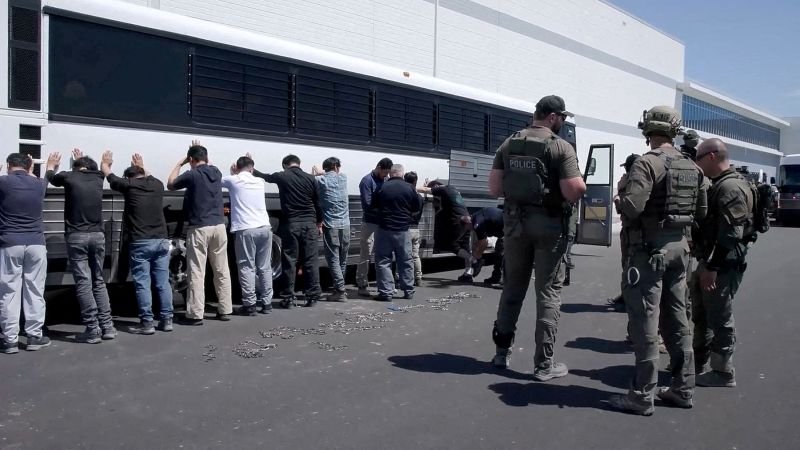
On September 4, 2025, federal agents descended on the sprawling Hyundai Metaplant complex in Ellabell, Georgia, roughly 25 miles west of Savannah. The operation, described by authorities as the largest single-site enforcement action in the history of Homeland Security Investigations, resulted in the detention of 475 workers — the vast majority of them South Korean nationals.
The workers ranged in age from their 20s to 60s and had been brought to the plant to install equipment and provide specialized technical training during construction of the facility’s battery plant, a joint venture between Hyundai and LG Energy Solution.
Yet a search warrant obtained by CNN named just four target individuals — none of them the Korean workers detained that day. The discrepancy between the stated justification and the scale of the operation has become central to the workers’ legal case.
Allegations of Unlawful Treatment and Detention Conditions
Several workers who spoke with CNN described their arrest and detention in harrowing detail. They allege they were taken into custody without explanation, without Korean interpreters, and in some cases were shackled at the wrists and ankles before being transported to the Folkston ICE Processing Center in Georgia.
Once inside the detention facility, workers say they were held in severely overcrowded rooms — some crammed with up to 80 men and only a few open toilets — under frigid conditions with barely enough clothing or bedding. Food that smelled sour and water that tasted off were common complaints. One worker, identified by the pseudonym Ryu, said he lost nearly 10 pounds during his detention.
Workers also say they were handed documents they could not read — later identified as consent-to-arrest forms and voluntary-departure agreements — without any translation. Several signed them believing the process would expedite their release. When one worker, identified as Kim, demanded to know what he had done wrong, he was allegedly told that simply being inside the factory was the violation, and that contesting it could take months — with one agent reportedly warning, “They might torture you.”
“The US government used the false pretext of finding four undocumented people to send hundreds of agents in full armor to storm the worksite of a Korean company that is one of the largest contributors to the American economy.”
Legal Strategy: The Federal Tort Claims Act
The workers’ legal team is pursuing claims under the Federal Tort Claims Act (FTCA), a powerful but often overlooked legal tool that allows individuals to sue the federal government for damages caused by its employees acting within the scope of their duties.
According to legal experts, the FTCA serves a dual purpose. It not only opens the door to federal lawsuits and potential financial compensation, but it also compels the government to put on the record why the workers were detained, what evidence justified it, and whether officers followed established agency policy.
Nora Engstrom, a Stanford law professor and tort expert not involved in the case, explained that if the Department of Homeland Security does not respond to the claims within six months, the workers can proceed to federal court. Because the FTCA incorporates state law, the workers would need to demonstrate unlawful arrest under Georgia law. The government, she noted, will almost certainly argue that the claims are shielded by protections for “discretionary” government functions — though such protections were never intended to create blanket immunity.
Legal experts emphasize that each individual must file their own claim; a single filing cannot represent all workers. James E. Pfander, a Northwestern law professor, confirmed this requirement, noting that the FTCA demands every claimant exhaust their own remedies before the government.
| Key Legal Detail | Information |
|---|---|
| Legal Basis | Federal Tort Claims Act (FTCA) |
| Agencies Contacted | 9 federal agencies including DHS, ICE, CBP, FBI, DOJ, Labor |
| Response Deadline | 6 months before federal court filing |
| Precedent | 2018 Tennessee meatpacking raid: $1M+ settlement |
Government Response and Official Position
DHS, in responding to CNN’s inquiry, stated that ICE “executed a judicial search warrant as part of an ongoing criminal investigation into allegations of unlawful employment practices and other serious federal crimes.” CBP pointed to a September 2025 release asserting that those arrested “were found to be working illegally, in violation of the terms of their visas and/or statuses.”
Steven Schrank, a Homeland Security Investigations special agent in charge at the time of the detentions, stated that all those taken into custody were suspected of living and working illegally in the US — some having entered without authorization, some having overstayed visas, and others holding visa waivers that prohibited employment.
The White House, when asked about the raid, pointed CNN to a Truth Social post from last year in which Trump urged foreign companies to “bring their people of expertise for a period of time to teach and train our people,” then “phase out” and go home.
When questioned about workers who later returned to the US on the same visas to do the same work, CBP told CNN that admissibility decisions are “made on a case-by-case basis” and that holding a non-immigrant visa or an approved ESTA “does not guarantee that you will be admitted into the United States.”
Despite the workers’ allegations, ICE did not respond to CNN’s request for comment on the reported threat against Kim, and neither ICE nor South Korea’s Foreign Ministry responded to questions about the legal basis for the raid or the conditions of detention.
Impact on the Hyundai Plant and Workers’ Lives
The raid initially halted construction at the 2,900-acre Hyundai Metaplant, which comprises a Hyundai EV manufacturing site and an EV battery plant under construction as a joint venture with LG Energy Solution. Construction resumed with a mix of new and returning workers, according to HL-GA Battery Co.
The facility has since been completed and entered commercial production, with its first battery cell shipment delivered in May. The joint venture HLBMA reported it now employs more than 500 people on site, the majority hired locally, while noting it may “draw on specialized expertise from outside the country” for highly technical projects.
For the South Korean workers themselves, the aftermath has been a mix of resilience and lingering anxiety. Several have returned to the same Georgia plant to resume their jobs. Others have traveled to different US facilities for similar technical work, often on the same B-1 business visitor visas that permitted training and equipment installation — though such visas technically bar production work or receiving a US paycheck.
Workers now carry company-issued cards listing their visa status, employer, and job details — a new precaution adopted since the Georgia raid, in case immigration enforcement targets them again.
“Before, my image of the US was that it’s a powerful country, a wealthy country, an ally. So I didn’t really feel anxious. That image has been greatly shattered.”
Broader Implications: Manufacturing, Immigration Policy, and Diplomacy
The raid is widely viewed as a collision between two competing Trump administration priorities: strengthening American manufacturing and pursuing aggressive immigration enforcement. The tension between these goals has placed the South Korean government in a difficult position, with citizens expressing concern that the incident could damage the US-South Korea alliance.
For years, Washington has pressured Seoul to invest on American soil, most recently leveraging tariff threats to extract approximately $350 billion in commitments. The Hyundai-LG battery plant represents one of South Korea’s most significant investments in the US.
Industry officials note that US manufacturers frequently rely on foreign specialists to build and launch new plants, but that the existing visa system does not easily accommodate the temporary, highly specialized nature of these assignments. Workers and their advocates say the system is poorly suited for the brief, project-based technical expertise required during construction phases.
LG Energy Solution, in a statement to CNN, said it “prioritize(s) strict compliance” and sends experts only temporarily until plants can operate independently.
Workers Seek Accountability, Not Just Damages
For many of the detained workers, the legal claims represent something beyond financial compensation. Choi, a field engineer who has returned to the Georgia plant, told CNN the claim is about vindication.
“The thing that angers me the most is that there hasn’t been any kind of apology,” he said. “We were all taken, locked up, and left the US as if we were expelled.”
The attorney representing the workers said the aim of filing the claims is to have the US government acknowledge what she calls an “enormous, unjust mistake” and to “admit it and apologize.” The claims seek damages for confiscated belongings, lost work, and psychological harm, alleging false imprisonment, abuse of process, and intentional infliction of emotional distress. The lawyer declined to specify the amount of damages being sought for each of the 300 workers.
Workers like Jung, a software engineer who flew to Cleveland for equipment work and stayed for months despite his fears, continue to weigh the economic necessity of returning to the US against the risk of detention. “Even though I’m still scared,” he said, “I have no choice but to go.”
As the legal process unfolds, the case will test the boundaries of federal enforcement authority over lawful foreign workers contributing to American manufacturing — and could set a significant precedent for how the government conducts future workplace immigration operations.
News, Government, Law, Society, Transportation, Industrial, People, International

