

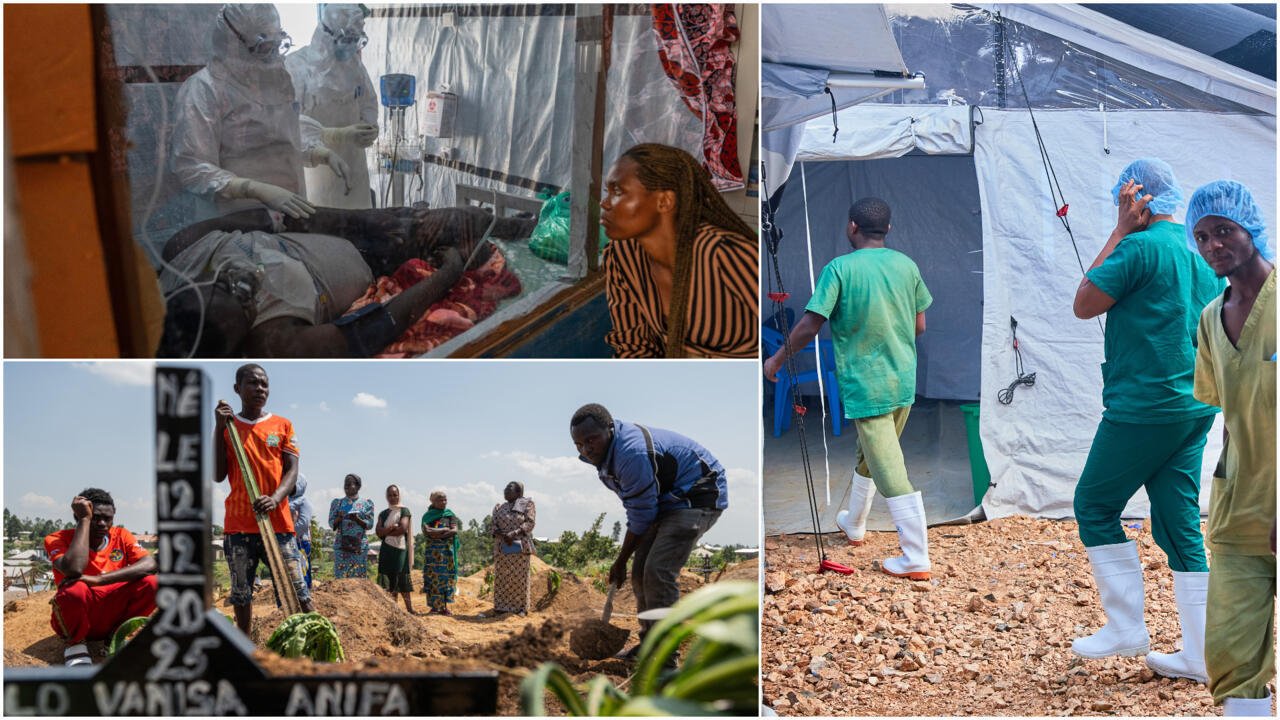
On May 15, 2026, the Democratic Republic of the Congo (DRC) announced that the 17th Ebola epidemic had been detected in the east of its territory, the epicenter of which was the province of Ituri. Two months later, the progression of the Bundibugyo virus is outpacing the measures taken. Explanations.
There is noise at the end of the line. Voices rise, someone shouts. Rodrigue Alitanu, director of operations for the NGO Alliance for International Medical Action (Alima), seeks a quieter spot in the courtyard of his office in Bunia, in the northeastern Democratic Republic of Congo (RDC). ” Sorry, friends, sorry. I’m at an interview “, he tells everyone before catching his breath. July 15, 2026 marks two months since the 17th epidemicEbola was officially announced in the DRC.
On the ground, the noise never really stops: the noise of machining centers running at full capacity, the noise of community alerts that pile up, and the noise of strikes that erupt when bonuses are slow to arrive.
Two months after the first confirmed case, the epidemic continues to gain momentum, and at this stage no one knows where its peak is.
More than 750 deaths and more than 2,000 cases have been identified.
The story begins in Mongbwalu, in the territory of Djugu, in the eastern province of Ituri, at the end of April. According to the timeline set by the Center for Public Health Emergency Operations (Cousp), the first suspected case began showing symptoms on April 24. A few days later, a second case appears in the same family: transmission within the home has already occurred, even before anyone utters the word Ebola. On April 27, the first patient died. The next day is the second. It was only on May 11, after an emergency meeting and the dispatch of an investigative team to Mongbwalu and Rwampara, that the warning was taken seriously. Samples were collected on May 12 and in-depth tests were carried out at the National Institute of Biomedical Research (INRB) in Kinshasa on May 13: eight out of thirteen samples were positive for the non-Zairean Ebola virus. Sequencing decision will be made on May 15: Bundibugyo virus. On that day, the Ministry of Health officially announced the 17th epidemic in the country. Two days later, the WHO classified it as a “public health emergency of international concern.”
Since then, the curve has never changed. The number of confirmed cases has tripled in less than five weeks, from 650 to nearly 2,000 as of July 12, while the number of deaths has more than quintupled in the same period, from 130 to more than 700, according to Doctors Without Borders (MSF).
Also readEbola: the scale of the epidemic exceeds official estimates by “two to four times”, according to WHO
Fastest growing Ebola epidemic
Week after week, Cousp’s numbers tell the same story: in the 25th and 26th epidemiological weeks, between June and July, there were more than 300 new confirmed cases each. As of July 13, the number of cases was 2,011 cases and 754 deaths, corresponding to a case fatality rate of 37.5%. MSF is already calling this the third largest Ebola epidemic ever recorded and the one that is growing the fastest. In two months, it exceeded half the number of cases recorded during the country’s previous major epidemic, 2018-2020, which lasted almost two years.
Two months later, Ituri remains the main hotspot of the epidemic, with 89.9% of cases and 83.7% of deaths concentrated in Bunia, Rwampara, Mongbwalu, Nizi and Nyankunda, among others. But the map has expanded. North Kivu, which has been affected for weeks, has 182 cases. Two provinces have been added in recent days: Haut-Uélé, where 14 cases were confirmed, including seven reclassified as imported from the Nia-Nia health zone, all of whom died in the community without even reaching a health facility, and Tshopo, where Kisangani now has four cases linked to the same epidemiological corridor. ” We are at a crossroads, in Ituri in Bunia, a crossroads that connects several provinces. “, Rodrigue explains to Alitan. According to him, it is through this intersection that outbreaks of infection flare up again as the population moves.
Also listenVisitor from Africa Midi – Ebola in DRC: “The fight in Kisangani is to restrict mobility and identify all suspected cases”, according to the Minister of Health
Delay between negation and delays
” The epidemic is growing faster than the response. “This phrase is heard several times in the mouth of the operational director of Alima. He says this not as an admission of failure, but as a description of the balance of power that has not changed since May.
He said this was due to two factors: the initial denial of the population in an area that had experienced Ebola in the past, and the time it took to respond, a time during which the virus continued to circulate invisibly in several health zones.
On the ground, this delay can be seen in contact tracing numbers. As of July 13, only 67.4% of nationally reported contacts had actually been seen, well below the 95% threshold recommended by health authorities. In Ituri, seven health zones did not even send a monitoring report that day. In Haut-Uel, slightly more than one of the two contacts was found.
However, each invisible contact represents a chain of transmission that continues to go somewhere that no one yet knows about.
Also readEbola in the DRC: how four patients reached Kisangani from Ituri without being detected
Centers are overcrowded, patients arrive too late
In Bunia, the Elikya Treatment Center with 90 beds operates almost constantly at full capacity. ” People regularly tell us that they prefer to wait at home and only come when space becomes available. “says Sylvie Kaczmarczyk, MSF emergency coordinator on site. The consequence, she said, is patients who arrive already in critical condition. In Mongbwalu, the doctor in charge of MSF’s programs, Ayokunnu Raji, gives a comparable estimate: 57 survivors have been treated since the NGO intervention began, compared with more than 110 patients who have died. The Cousp report provides insight into this saturation across the country: as of July 13, isolation ward occupancy reached 120.6% in North Kivu and 82.7% in Ituri, where 753 patients were hospitalized, including 246 confirmed cases.
Rodrigue Alitanu describes another side of the same problem: death in the community, patients who die at home without even meeting a caregiver. This is where, he says, a crucial part of the infection continues to occur: at home, in markets, at funerals, rather than in the treatment centers themselves.
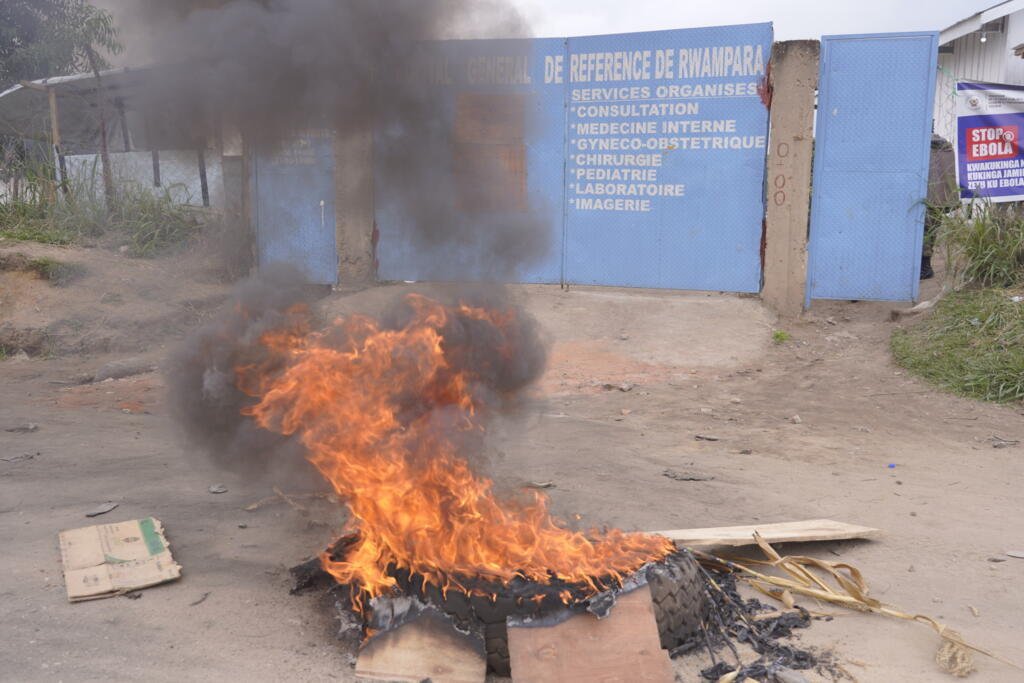
On July 13, 2026, staff at an Ebola treatment center went on strike to demand unpaid wages and bonuses at the Rwampara General Hospital in Ituri province in northeastern Congo.
Caregivers between response measures, deaths and strikes
According to Rodrigue Alitanu, there are always two threats: denial, which is gradually receding due to increased awareness, and social movements among nurses associated with delays or disagreements over bonuses. ” A specific example is the end of support “He explains. “The striking center can no longer triage new cases. They then remain in the community or in non-specialized settings, with an increased risk of infection and, for already hospitalized patients whose care is interrupted, a higher risk of death.”
The 13 July Kusp report confirms, although it does not call it a strike, a symptom of the same evil in Rwampara: dignified and safe funerals there are paralyzed due to lack of payment to the teams responsible for carrying them out. The document also mentions community resistance in Mandim and nine pending reports in Nizi, where kits are planned to be distributed to try to resolve the situation.
Caregivers themselves are paying the price for this epidemic. According to Cuspa, in Ituri, 114 frontline workers have been infected since the start of the response: 58 have recovered, 20 are still hospitalized, 36 have died, i.e. the mortality rate was 31.6%, which is higher than in the general population. Bunia, Rwampara and Mongbwalu concentrate most of this pollution. ” There is no such thing as zero risk “, admits Rodrigue Alitanu, who confirms that Alima herself suffered, despite the protection protocols in place. This ensures that care for infected caregivers is immediate and that the majority of cases reported since the start of the response have a favorable outcome.
Also read“Why them?” In the DRC, these families destroyed by Ebola in Ituri have already suffered from war
There is no approved treatment or vaccine, but there are two therapeutic trials.
As the virus advances, research is trying to catch up. To date, there is no proven treatment or vaccine for Ebola-Bundibugyo virus. Since July 6, the PARTNERS trial, coordinated by WHO with the participation of Alima, has been testing two new molecules on already confirmed patients at one of the centers in Bunia.
A second trial began on July 14: EBO-PEP, coordinated by Alima, INRB and ANRS Emerging Infectious Diseases, is evaluating the oral antiviral obeldesivir as a preventive treatment in people who have had a high-risk contact with a confirmed case within five days of infection. About 1,000 participants are expected to be monitored daily for 21 days from centers attached to Alima structures in Bunia and Rwampara.
A third observational study should begin in the coming weeks to better understand the clinical evolution of the disease, Rodrigue Alitanu said. ” We are in the business of prevention and we are in the business of therapy. ” he summarizes, describing the first two trials as two sides of the same strategy: preventing an outbreak of the disease in those who have been exposed, and better treating those who have already contracted it.
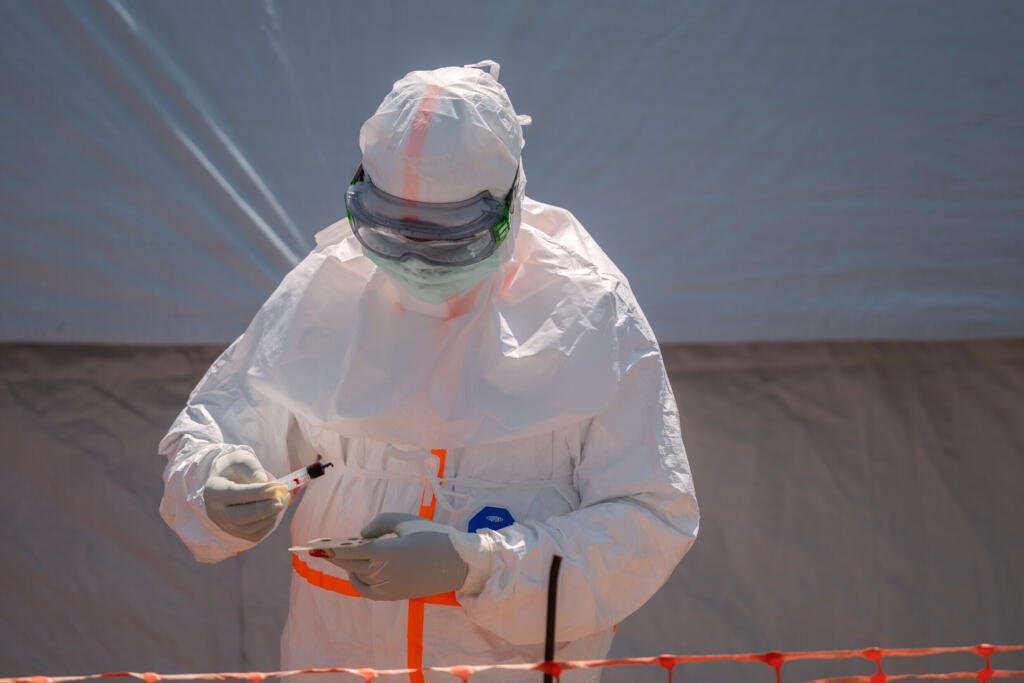
A health worker prepares a patient’s blood sample for testing at a general hospital in Bunia, Congo, June 11, 2026. AP Photo/Moses Sawasawa – Moses Sawasawa
A question that remains open
Finally, Rodrigue Alitanu makes a call: for national coordination that will finally be able to act simultaneously in areas that are already affected and in those that are not yet affected, instead of chasing, as today, an epidemic that is always one step ahead.
On the ground, on the sidelines of official exchanges, these concerns are echoed. A doctor involved in the Mongbwala response, who spoke on condition of anonymity, believes that some of the pillars of coordination, particularly surveillance and community mobilization, are still struggling to function uniformly, and that areas not yet affected remain ill-prepared to prevent new outbreaks occurring there. The same source mentions – as a personal hypothesis rather than an official forecast – the possibility that the epidemic will spread well beyond this year if current dynamics do not change.
Two months after the first confirmed case, the Bundibugyo epidemic has not yet reached its peak at this stage. This is confirmed by Rodrigue Alitana from this courtyard in Bunia, where the noise, on this day, as on any other, never stopped.