

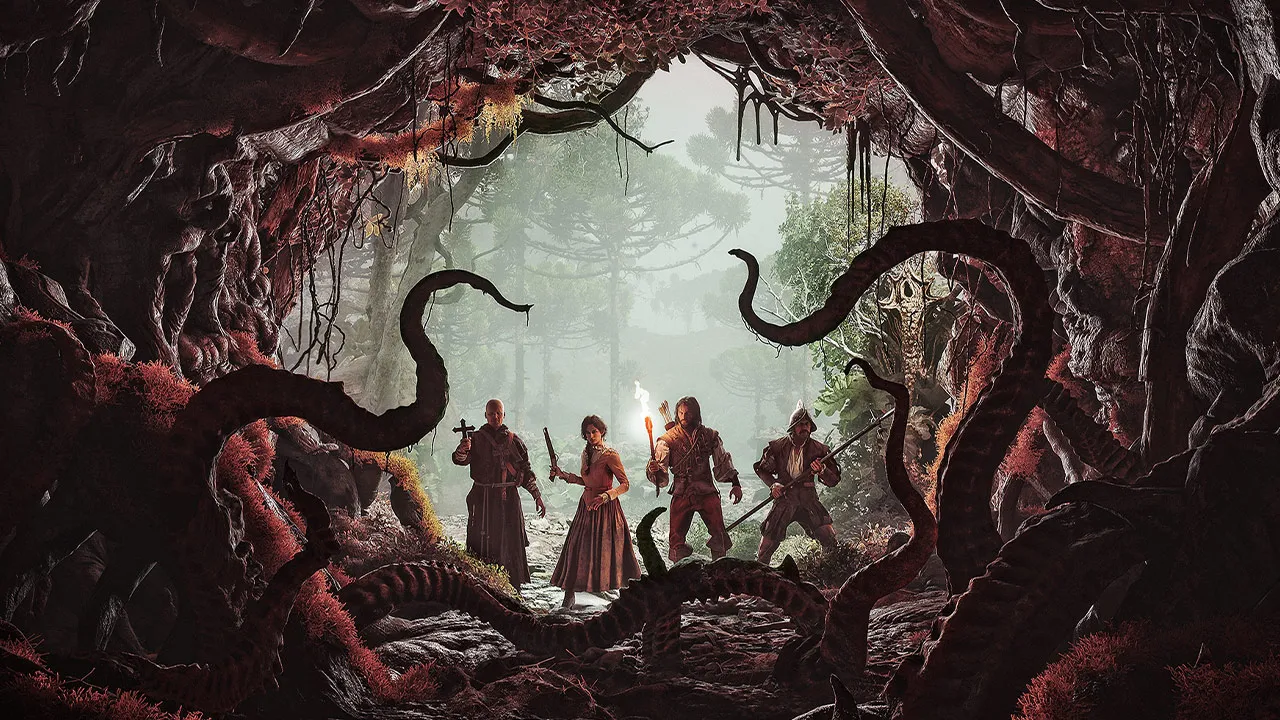
The essence of The Mound: Omen of Cthulhu as a co-op survival horror game is best summed up by the moment I found myself repeatedly screaming at my friend, asking what the hell he was laughing at before he was brutally murdered. You see, it wasn’t my friend at all, but No-Face using his character model and repeatedly replaying his recorded laugh earlier in the match. But when it gets to the point where I feel like I’m going crazy, The Mound’s clever madness effects sometimes fall by the wayside, giving way to a relentless difficulty that doesn’t always respect my time or make it easy to recruit new allies.
It took more than 50 expeditions and nearly 50 hours of exploration into the beautiful Chilean wilderness to uncover all the secrets of Mound’s rich environment in the mid-1600s. You and your friends take on the role of conquistadors, ignoring every possible warning of danger to enrich yourself and the Spanish crown, while avoiding the restless dead and invading the strange tombs of alien gods. When it comes to capturing the atmosphere of the Cthulhu Mythos, the developers at ACE Team have done a fantastic job.
Of course, when I hear “Lovecraft” and “Conquistadors” in the same sentence, I immediately see the potential for a twisted synergy between them that we might call “advanced racism.” And for the most part, Omen of Cthulhu threads that needle quite well, as many of the later adaptations of Lovecraft’s works have tried to do. The region’s real-life Mapuche natives are mentioned several times in the story and are clearly not identified with the strange cultists of the Elder Gods who live deeper in the jungle.
I would have liked to see a little more Mapuche, and yet there is still the feeling that the New World is a wild wasteland of nightmares and dark magic that plays into some colonial stereotypes. But it’s definitely better than Lovecraft’s original version of the story. The story of the Mound and the secrets hidden beneath it is told in powerful journal entries with superb voice acting. I really enjoyed gradually learning what was going on, and the late game events are dramatic and satisfying.
Mortal danger
Across 18 detailed maps that connect into one large world (though you can only access one section at a time), you complete contracts that specify an objective, a potential reward, and a certain amount of gear depending on the number of players, up to a maximum of four. I think this way of handling equipment is quite reasonable. For example, there are often not enough weapons for everyone, so you have to decide who in the group will be in charge of combat, who will hold a lantern in dark places, and who can simply leave their inventory slots empty to carry more loot. It also allows you to try out different equipment and not fall into the rut of bringing the same equipment every time.
However, after about 20 hours, I ran into a problem with how contracts work: the random assortment offered seems to scale based on the character level of the server host. This meant that if I wanted to bring a new friend who hadn’t played before, I could completely run out of basic and even medium difficulty contracts to make it easier for them. I appreciate that in co-op horror games like Phasmophobia, I can farm newbie missions over and over again for resources and choose difficulty settings friendly to the allies I’ve invited along. Especially considering that Kurgan can be unbearable even on basic expeditions.
The reveals at the end of the game are dramatic and satisfying.“
The group I’m playing with is also an experienced co-op team, having spent hundreds of hours together in games like Phasmophobia, Lethal Company, Abiotic Factor and Valheim. We are not newbies. And we all pretty quickly came to the conclusion that, to put it bluntly, “The Kurgan” is really damn cool. Some of this can be mitigated by learning how specific mechanics work. For example, most expeditions have a timer, which we found doesn’t really matter, and it’s more important to move quietly so as not to upset the deadliest creatures of the forest.
But even when we felt like we were doing everything right, sometimes the number and lethality of enemies simply scaled too quickly to provide a satisfying challenge without feeling overwhelming. When there are four of us against a dozen zombies and there is no room to get through or get around, even on the lowest difficulty level, what exactly should we do? And this is assuming that there are still basic contracts left in the registry that you can try.
The absolute worst are the portal missions, which leave you without the usual oxcart to transport your stuff and require you to navigate a modified version of the map covered in purple goo that will instantly kill you if you stand on it for about three seconds, which also prevents your friends from getting close enough to revive you. I can’t remember ever having a good time on one of these missions and ended up avoiding them whenever possible. After seven or eight failed expeditions, we’ve often wondered if this was truly the intended experience or if we were missing some key mechanic that would make it fair, and it seems the answer is the former.
The problem isn’t so much that Advanced and Legendary missions are really difficult. They must be! I want to have something to strive for. What’s more, there’s not enough scope to tailor the difficulty to suit your group or mood. The floor is too high. However, I should mention that a fairly large patch came out about a day before this review, which, among other things, changed the difficulty, but it arrived so late that I haven’t been able to put it through extensive testing yet. However, after a couple of expeditions the situation did not change much.
Army of Darkness
There is some meta progression between contracts to ease the pressure, but most character levels simply unlock new knife skins that are purely cosmetic. Buying or upgrading gear before a difficult map is a good option, but since you lose all those extras and upgrades if you die, it’s very easy to fail a bounty multiple times at an advanced or legendary level, end up broke, and have no way to quickly find some money in calmer waters before trying again.
It’s a shame, because when The Mound isn’t overly oppressive, the elements of intense combat and horror work well together. The variety of enemies is impressive, drawn from the deepest recesses of the Cthulhu Mythos and ranging from the most basic creepy possessed humans to the very strange, reality-bending horrors that may not even be able to be killed, forcing your party to get around them in special and clever ways. Resource management is key, and the variable value of treasure leads to exciting decisions for those times when you’re not sure you’ve collected enough to meet your quota, but the jungle is angry.
It’s also hard to recommend The Mound if you want to play alone. An NPC companion will appear to help you, but they are not as competent as a human ally, and trying to complete the contract yourself can be a major challenge, even if the number of enemies is reduced a bit. “Co-op is better in co-op” isn’t exactly a shocker, but since they give you the ability to fly solo, it’s still worth noting.