

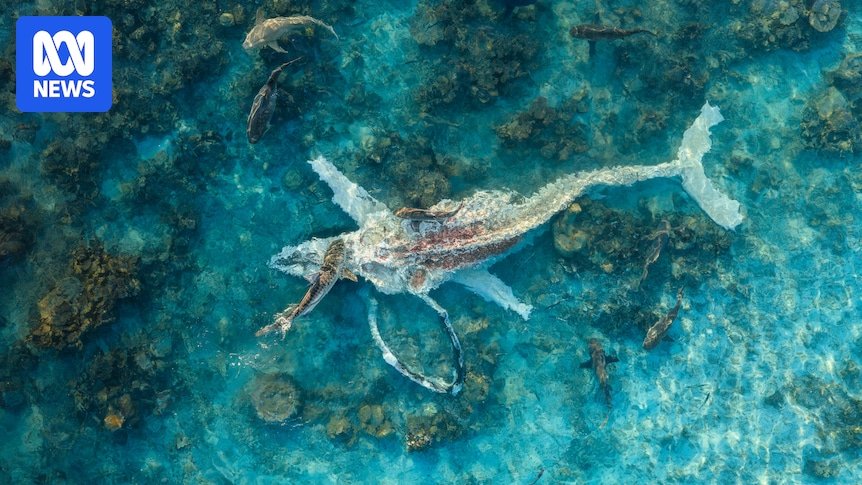
The decomposing carcass of a humpback whale has closed two popular Western Australian beaches during the height of the school holidays as sharks converged on the area.
But experts say the cause of the whale’s death is more concerning.
Rescue teams were called to the 9m animal on Wednesday evening after it was spotted struggling with fishing lines near Osprey Bay, more than 1300 kilometers north of Perth.
Although the crew was able to partially free the whale, its injuries were fatal.
By morning, high tides had pulled its multi-tonne hull into the shallow waters of Ningaloo Reef, forcing authorities to close some of the coast’s most famous diving spots during the peak tourist season.

Rescuers have been prepared at the scene. (Supplied: DBCA)
WA’s Department of Biodiversity, Conservation and Attractions (DBCA) said it was too early to say when beaches adjacent to Oyster Stacks and North Mandu would reopen, but the shark warning could remain in place for several weeks.
Numerous whale entanglements
Every winter, up to 40,000 humpback whales swim past Ningaloo Reef in one of the largest migrations in the world.
Nearby Exmouth Bay is of particular importance to mother-calf pairs.
It provides a nursery and rest stop on the route north from Antarctic feeding grounds to the spawning waters of the Kimberley.
One of the entangled whales was tracked from the air. (Supplied by: Ningaloo Aviation.)
Last week’s dead whale was among five reef entanglements reported to the DBCA over the same number of days.
Rescuers were able to free only one and three others could not be found after extensive searches by air and sea.
“Five entanglement reports in five days is quite a lot,” said DBCA Exmouth marine program coordinator Sam Miles.
“We are all trying our best to get these animals out, but it takes a lot of effort.
“These are always sad events and we don’t want to see that.”
Calls for investigation
While entanglements occur annually, local wildlife specialist Brinkley Davis said the uptick is concerning.
“We’re seeing a lot of rope that matches commercial fishing gear like crab and crayfish pots,” she said.
“And there is a lot of uncertainty about where they came from and why there are more of them this year.”
Loading…
The Baloo Blue Foundation, led by Ms Davis, relays messages about whales in distress through its 24-hour text line, sharing tips with the DBCA.
She said the whales had only started arriving in large numbers in the last two weeks, even though the migration usually occurs from June to November.
“We really want to … start investigating entanglement hotspots and what can be done from a fisheries perspective.”
Ms. Davis said.
Ocean photographer Brooke Pike captured schools of sharks approaching the carcass. (ABC Pilbara: Alistair Bates)
Exmouth photographer Brooke Pike used her drone to capture dozens of sharks swarming the whale carcass.
“There were loads of sharks there, from tiger sharks to bull sharks to nurse sharks,” Ms Pike said.
“Therefore, it is definitely not recommended to snorkel or swim in the area until the environment has properly cleared the carcass.”
Report but don’t interfere
Marine mammal ecologist Kate Sprogis said the whales were likely dragging ropes hundreds of kilometers from more heavily fished areas of the south coast.
“If someone sees a piece of rope lying in the ocean and washed ashore by the waves, the best thing to do is remove it,” Dr. Sporgis said.
“It is one of the leading causes of death for large whales worldwide.”
One humpback was released. (Attached: Dani Rob/DBCA/File)
The string of incidents coincides with an unusually low number of whale sightings migrating through Western Australia’s south-west region.
DBCA’s Sam Miles urged anyone who spots an entangled whale to quickly notify authorities, but not try to cut the lines themselves.
“If people cut off these ropes and floats, we will have a very, very difficult time finding the animal,” he said.
“The faster the message is received, the faster we can respond.”