

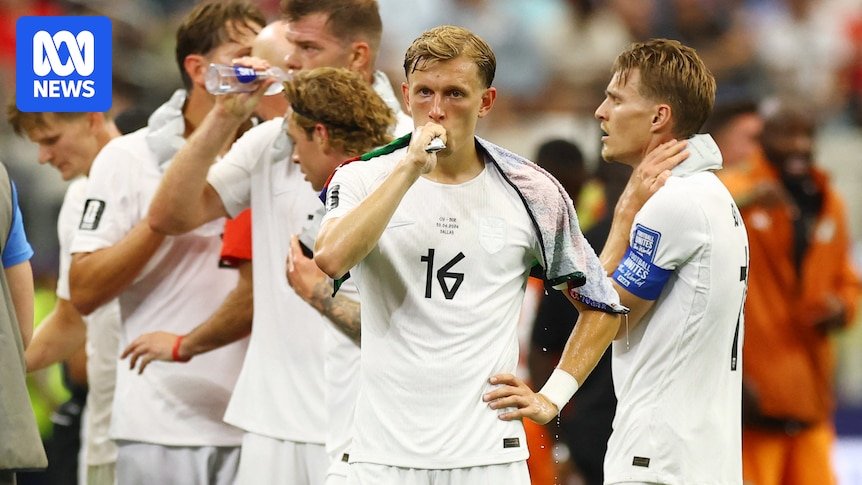
While the World Cup showcases football’s greatest sporting event, athletes and players of all stripes alike are plagued by a common enemy: heat.
North America is still in the grip of a record heat wave.
Those preparing for tomorrow morning’s World Cup semi-final between Norway and England can expect quite a hot match, with temperatures expected to reach 43 degrees Celsius in Miami.
There is even talk that heat protocols could force the game to be postponed, but that seems unlikely given the TV ratings.
Players struggled through one of the hottest games in the tournament’s history last Sunday as France took on Paraguay in Philadelphia with temperatures hovering around 38C in the early evening.

France goalkeeper Mike Maignan takes a drink before the World Cup match against Paraguay. (AP: Martin Meissner)
It follows harsh conditions during the group stage games, nine of which met global players’ union FIFPro’s thresholds for delay or postponement.
The only two matches considered hotter than the one between France and Paraguay were played in broad daylight more than 30 years ago at the first American World Cup, when pitch temperatures reportedly reached 43C and 48C in Florida and Texas respectively.
The field and rafters of Philadelphia Stadium were almost certainly hotter than predicted, with temperatures on the field possibly exceeding 43°C.
“Especially in these outdoor stadiums, (you have) limited airflow… so when you’re on the field, you don’t get the natural wind… the direct sun hits the field,” Climate Central meteorologist Shel Winkley said.
The body heat emanating from tens of thousands of fans and the stadium itself, made of concrete and steel, also contributed.
“You’re essentially creating this little microclimate within what is a larger heat dome that we experienced over Philadelphia,” he said.
The players weren’t the only ones feeling the heat ahead of Paraguay’s match against France. (Reuters: Gina Moon)
What led to such exceptional heat? The answer, according to Mr Winkley, lies in human-caused climate change.
“We knew that going into this match there was a greater than 60 percent chance (the athletes) would experience some kind of performance-impairing heat, meaning temperatures above (28C),” he said.
“We know that based on the carbon dioxide emissions we’ve put into the atmosphere, those percentage points have gone up by about 17 percent.
“These temperatures have become at least three to four times more likely due to climate change.”
How hot is too hot?
Organizers are well aware of the heat issue and have taken steps to better manage it this time around.
Artificial turf was banned, mandatory three-minute drinking breaks were introduced and, to the detriment of millions of European spectators, no matches were scheduled in Florida until 5 p.m.
Games in Texas are played in expensive, climate-controlled stadiums.
Football’s governing body FIFA’s own rules dictate that a game must be reviewed when the wet-bulb temperature – a measure that takes into account the insulating effect of humidity – reaches 32C. The players’ union argues the amount should be lower.
Researchers at the 2014 World Cup in Brazil found that the best time for elite soccer players to perform was in low-humidity weather, below 22°C. The worst was 28C and above.
Drink breaks have proven to be an unpopular addition among fans, who claim they ruin the flow of the game. (Reuters: Amanda Perobelli)
Scientist Matt Brearley, who worked as a heat specialist for the Australian Olympic team in Beijing in 2008, says professional athletes cope much better with temperatures that would send ordinary people to the emergency room, but there are limits.
“We’re starting to see their performance deteriorate… if they’re playing one-on-one, they can start to shut down and you’ll see them limiting their physical activity,” he said.
“It’s the brain that controls them that says, ‘We can’t keep producing this much heat, we’re overheating.’
Lewis Miller drinks during Australia’s match against Japan. Additional drink breaks will be mandatory at the 2026 World Cup. (Getty Images: James Worsfold)
Signs that a football player may be experiencing heat stress include sagging, slouching and stumbling around the field. They will have difficulty communicating with their teammates.
“And eventually, if that’s not enough to replace them and they continue to be exposed and continue to generate heat, they will break down,” Dr. Brearley said.
The future of World Cup tournaments
Qatar’s winning bid to host the 2022 tournament in the flat, barren desert was widely criticized by fans as a major symbol of FIFA corruption.
How could a football tournament be held in the desert in the summer, I thought.
The hydration break farce was the biggest insult to tired World Cup fans
The answer – moving the match to the winter – has upended the schedules of Premier Leagues around the world.
The extremely unpopular decision will be repeated at the 2034 tournament in Saudi Arabia.
But this may have to be repeated for host countries outside the Gulf in the future.
Conditions at this World Cup are even hotter than in Qatar, and those expecting a postponement at the next championship may have to adjust their expectations.
During the same period in 2030, it is planned to be held jointly in Southern Europe, which is currently experiencing record heat, and Morocco.
Weather delays can have economic consequences and negatively impact the fan experience. (AP: Seth Wenig)
These difficulties are not limited to the World Cup. A warmer planet could change the way billions of fans play the sports they love.
“If we continue to experience the same trends, will we be able to safely play games outdoors, or do we need to start investing in additional infrastructure that brings these games indoors?” – said Mr. Winkley.
“Football, soccer, cricket, baseball, whatever it is, it really changes what you remember about the game when you were a kid and maybe how you experience the game with your kids.”
Turkish tennis player Zeynep Sonmez helps a girl with a ball who passed out during the heat at the 2026 Australian Open. (Reuters: Edgar Su)
Dr Brearley said the impact of hot weather on sport was gradual.
“I sometimes call it ‘climate creep’ because with the term ‘climate change’ people say, ‘Well, has it changed?’ – he said.
“It hasn’t changed, it’s creeping forward.
“Thirty years ago (Northern Territory spectators) could watch a football match and even daytime games in the shade weren’t too bad.
“Now it could be so hot that they have to cancel the games because it’s not only dangerous for the athletes, (but) for the parents and grandparents and family and friends in the stands.”