
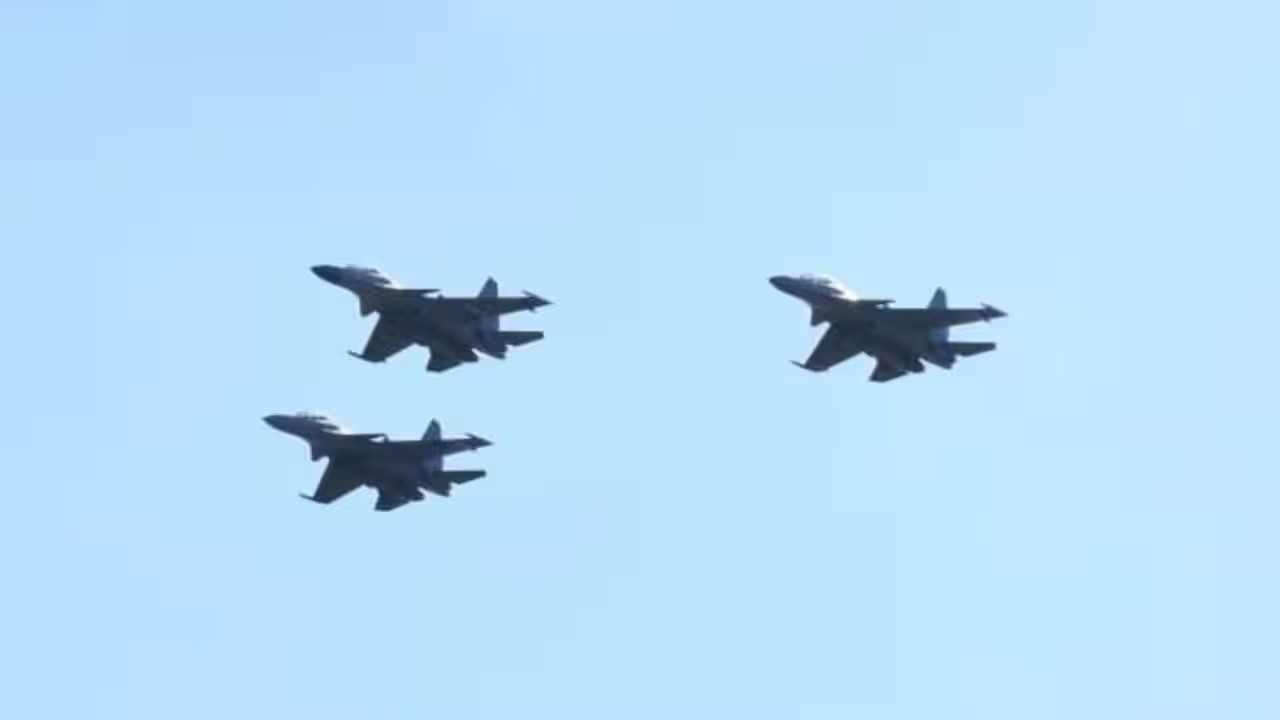
A formation of three Su-30 MKIs is flying in formation. (Image credit: Indian Air Force)
The World Directory of Modern Military Aircraft (WDMMA) has once again ranked the Indian Air Force third on its list for 2026, behind the US and Russia. In particular, the Chinese People’s Liberation Army Air Force (PLAAF) ranks fourth. This is the fifth time since 2022 that the US Air Force has ranked ahead of the PLA Air Force, and the sixth time overall it has trailed the US Air Force, US Navy, Russian Air Force, US Army and US Marine Corps.
How the Indian Air Force defies the numbers and beats China in global air force rankings for the fifth year in a row
WDMMA uses a proprietary system called True Value Rating (TVR) to rate air forces. A total of 103 air forces are rated, and the highest attainable score, 242.9, belongs to the United States Air Force. The organization evaluates 129 air carriers in 103 countries and tracks more than 48,000 aircraft in a wide variety of roles.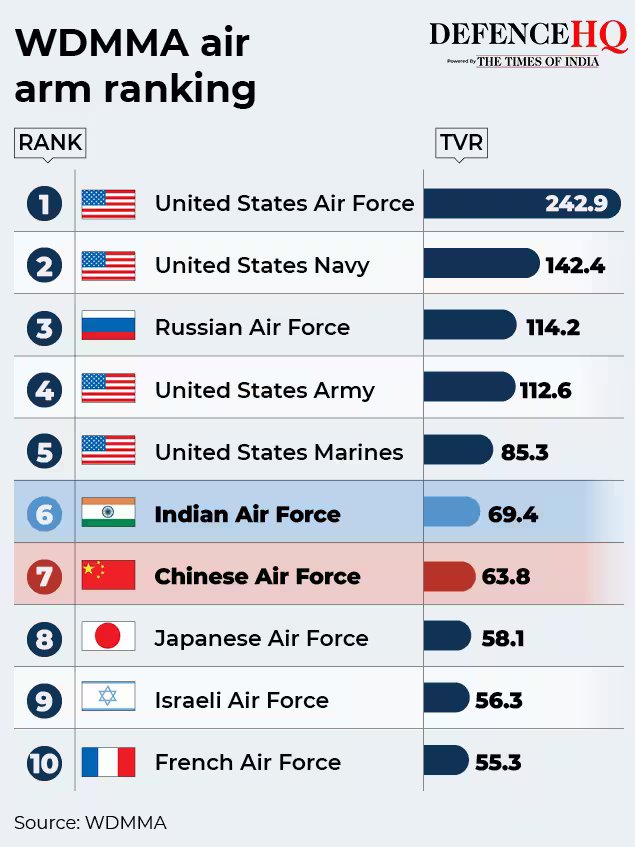 TVR is based on a formula that takes into account fleet size, composition, modernization, logistics support and overall capabilities. More emphasis is placed on fleet composition and specialized capabilities such as special mission aircraft, aerial tankers, close air support platforms, transport vehicles and trainer aircraft, rather than just the number of fighter aircraft. Particular attention is also paid to the aircraft weapons order portfolio and local aerospace manufacturing capabilities.
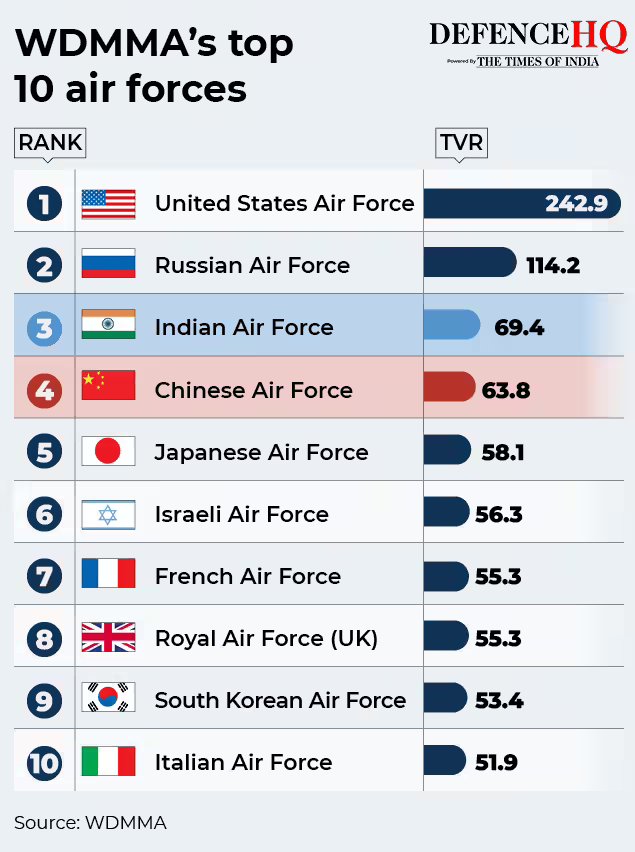 What explains India’s high ranking?WDMMA has a fleet of 1,716 aircraft in the Indian Air Force. Fighters make up the largest segment with 542 airframes of seven types, a number that oddly enough includes the MiG-21, which was retired in September 2025.
IAF Set to Receive First Made in India C295 in September – Here’s What the Milestone Means
The next largest component is helicopters, with 498 helicopters—almost 30% of the fleet. The largest type of helicopter is the Mi-17 (222), followed by 111 HAL Dhruv and Rudra helicopters. A total of 282 aircraft were transported, about 16% of the fleet. Trainer aircraft account for approximately 22%, with 374 aircraft available, of which 325 are pure trainers and the rest are type conversions (two-seat versions of single-seat fighters).Twenty aircraft are classified as special mission aircraft (aerial tankers, airborne early warning and reconnaissance platforms), representing just over 1% of the total.What the top-rated US Air Force looks likeA similar fighter composition is demonstrated by the US Air Force, which ranks first (fighters make up 32% of their fleet). Taking into account bombers and close air support aircraft, this share reaches 41% of the total fleet. Helicopters make up only 4% of the USAF fleet and vehicles 14%, in contrast to the USAF where helicopters and vehicles together make up 46% of the fleet. Special mission aircraft make up about 14%—about one in seven—of U.S. aircraft.Disadvantages of IAFThe Air Force is facing a shortage of aircraft, especially fighter jets, leading to a shortage of squadrons. The IAF’s sanctioned strength is 42 fighter squadrons, but it currently has 29. With 18 aircraft in each squadron, the IAF’s target fleet size is around 750 fighters. The service also needs more platforms for special missions.Critical shortages include airborne tankers, airborne early warning and control aircraft, electronic warfare capabilities and intelligence, surveillance, target acquisition and reconnaissance (ISTAR) platforms. The IAF is implementing several programs to address these gaps.Procurement and modernizationThe IAF has ordered 180 Tejas Mk-1A fighter jets in two tranches (83 and 97 aircraft). The first aircraft has already been produced and is awaiting final systems integration before entering service. Another purchase could add up to 114 Rafale fighter jets, increasing the fighter force by 294 aircraft. At the same time, more than 200 Jaguar, Mirage 2000 and MiG-29 aircraft are scheduled to be retired before the 2030s.Programs are also underway to acquire additional airborne warning and control systems and tanker aircraft to expand operational coverage. Last year, the Ministry of Defense approved the acquisition of the ISTAR platform. When these aircraft join the Indian Navy, they will strengthen the capabilities of the Air Force and improve the effective use of air power in both war and peace.